
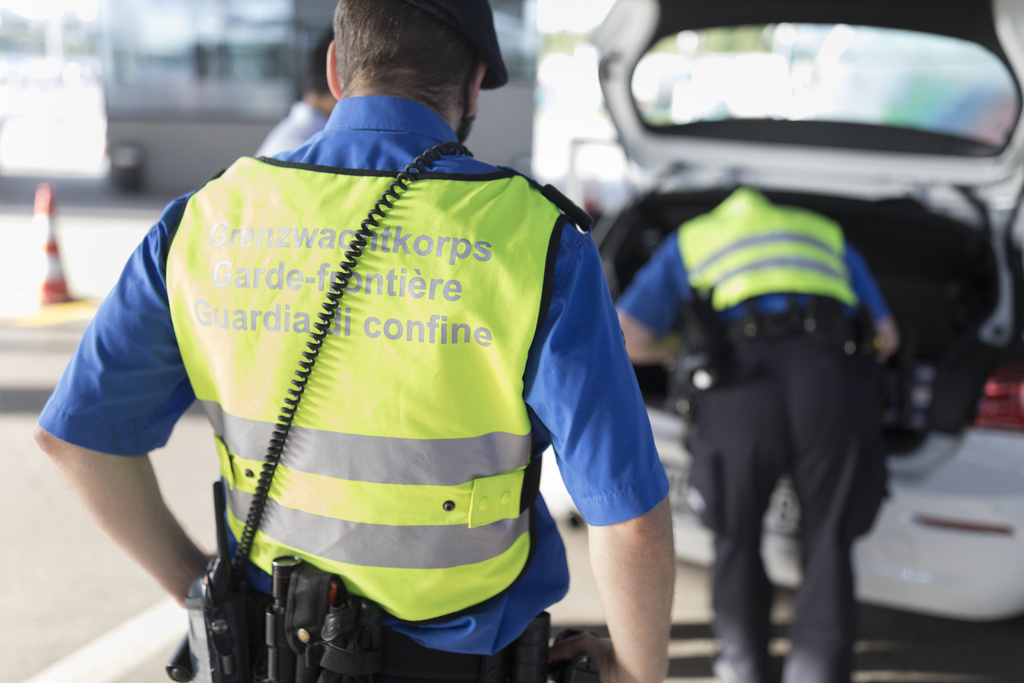
There is talk of confederal modernisation. In reality, a silent changeover is taking place. Under the guise of versatility and efficiency, the Confederation is in the process of dissolving essential areas of expertise into a standardised administrative mechanism - without a popular vote, without any real debate and without any clear democratic mandate. The customs-border guard merger is not a simple organisational adjustment: it is a profound transformation of the way in which the Confederation carries out its sovereign functions. And its consequences go far beyond the administrative framework.
You can't put all-season tyres on a race car without losing efficiency.
Why should we accept it for the protection of Switzerland's borders?
The imposed merger of customs officers and border guards within the new Federal Office of Customs and Border Protection (FOCB) is presented as a necessary modernisation. In reality, it is a functional regression, a organised deprofessionalisation and a silent alignment with foreign standards, to the detriment of efficiency, quality and Swiss sovereignty.
Entry into force on 1st January 2022, This reform merged two historically distinct bodies, totalling more than 4,000 employees, This is a major structural transformation that is underway at the Group level. A major structural transformation underway without a popular vote, and without a public debate on the consequences for the Confederation's sovereign missions.
Two professions, two missions, two approaches
Le customs officer is a specialist in law, economics and commercial fraud.
Le border guard is a professional in security, personal control and intervention.
These two professions are not interchangeable. They are based on specific skills, distinct approaches and expertise built up over many years. Merging them under the pretext of versatility is tantamount to denying the obvious: generalism weakens expertise.
An agent who knows how to do «a bit of everything» ends up doing the essentials less well.
The dangerous myth of versatility
The federal administration praises flexibility. But flexibility is not a quality in itself.
An all-season tyre is never excellent: it brakes less well in winter and holds up less well in summer. The same applies to the professions that fall within the sovereign remit of the Confederation.
In practice, an officer called upon to control complex flows - pharmaceutical products, precious metals, works of art, dual-use goods or sophisticated customs arrangements - cannot maintain the same level of legal, fiscal and economic expertise as a specialist customs officer who has spent years working on these cases.
Conversely, a professional trained in the surveillance, intervention and control of individuals will see his training, operational availability and security vigilance reduced by administrative and logistical tasks that are not part of his core business.
Diluting skills weakens :
-
complex fraud detection,
-
the quality of goods controls,
-
legal analysis skills,
-
and, paradoxically, safety.
This reform does not create more efficient professionals, but standardised agents, dependent on procedures, software and algorithms - where human discernment and experience on the ground remain irreplaceable.
An accounting reform, not a safety reform
Behind the talk of modernisation lies a more prosaic reality:
reduce costs, level out salaries and make staff more flexible.
In particular, the merger enables :
-
to mask job cuts,
-
forcing people to change jobs,
-
weaken professional bodies,
-
and to transform expert jobs into multi-skilled administrative functions.
Any reform that broadens the scope of jurisdiction without a proportional increase in the number of staff, training and time available mechanically produces the opposite effect to that announced: less control, more procedures, more technological dependence.
This is not a safety reform.
This is a budgetary reform.
Silent alignment with European Union practices
This point is rarely made publicly, but it is central.
Merging customs and border security brings Switzerland structurally closer to the models in force in the European Union, Customs functions are integrated into police and supranational systems.
The point here is not to imply political intentions, but to note an institutional convergence. When administrative architectures become similar, interoperability becomes a technical fact before becoming a political fact.
This transformation facilitates :
-
alignment with Schengen standards,
-
interconnection of information systems,
-
standardisation of control practices,
-
and, ultimately, the loss of decision-making autonomy.
In other words, Switzerland is aligning itself without a vote, without democratic debate and without a popular mandate.
An attack on sovereignty and democratic control
A sovereign state is recognised not only by the control of its borders, but also by the quality of its institutions.
By imposing this reform in a technocratic manner, the federal administration is bypassing political debate, marginalising field staff and weakening the role of Parliament.
Power slides insidiously:
-
from the elected representative to the administration,
-
from expertise to procedure,
-
from sovereignty to alignment.
Modernisation does not mean degradation
Nobody disputes the need to adapt the Confederation to contemporary challenges.
But modernising does not mean destroying professions, levelling skills or weakening quality in the name of flexibility.
Switzerland has never been strong on administrative generalism, but on :
-
precision,
-
specialisation,
-
responsibility,
-
and the professionalism of its institutions.
Because the Swiss Confederation is founded on the’Rule of law and the direct democracy, reforms affecting the fundamental functions of the Confederation should strengthen expertise, not dissolve it.
By trying to merge, standardise and align everything, we end up losing the essential: excellence, sovereignty and trust.
A clear call to parliamentarians: regain democratic control
Faced with a reform of this magnitude, parliamentary silence is not neutrality: it becomes an abdication.
Federally elected representatives not only have the right, but the homework, This is an issue that needs to be addressed immediately. Control over the organisation of the Confederation's sovereign tasks - border security, customs, territorial sovereignty - cannot be left to an autonomous, self-referential and increasingly opaque administrative mechanism.
It is time for Parliament to exercise its full powers:
-
sound right of review on the real impact of the customs-borders merger,
-
sound power of assessment operational, security and human impacts,
-
and its constitutional role as a counterweight faced with a federal administration that tends to reform itself without an explicit political mandate.
Failure to do so sets a dangerous precedent:
that of an administration that alone redefines the Confederation's missions, the sovereign core businesses
and the balance of sovereignty - without a vote, without debate, without clear political responsibility.
The modernisation of the confederation cannot be achieved by against direct democracy, nor outside parliamentary control.
When the administrative machinery gets out of hand, it's up to elected representatives to pull the emergency brake.
This is no longer a time for distant observation.
It is parliamentary mobilisation, This is an issue that directly affects Switzerland's security, sovereignty and institutional credibility.
We analyse what the media keep quiet. What Berne negotiates, we dissect. Join our HQ on Telegram now: https://t.me/swisssovereignty