
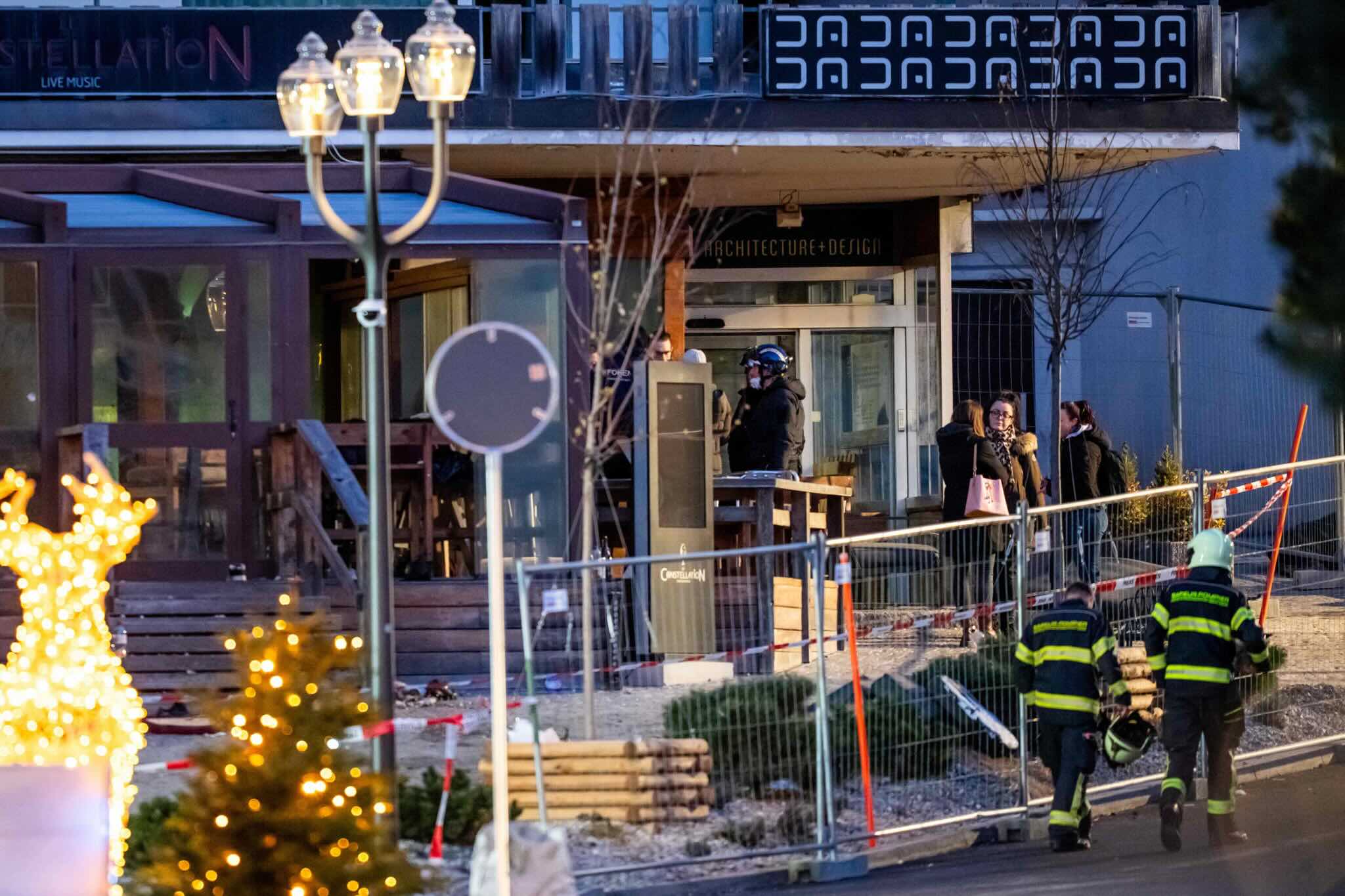
A tragedy of this magnitude does not tolerate grey areas or approximate accounts. When a tragedy claims dozens of lives, every minute, every word and every previous decision become political and judicial facts in their own right. In the case of Crans-Montana, however, a series of factual coincidences - a law that came into force 90 minutes before the fire, a disclaimer by the authorities, and the unexplained disappearance of the word «explosion» from an official communication - impose a single requirement: that of total transparency. To read what follows is not to suspect. It means refusing to let doubt replace proof.
We don't write to feed fantasies.
We are writing because a case involving almost 40 deaths and dozens of burn victims cannot survive obscurity. It can only survive proof, traceability and an investigation capable of neutralising all suspicion.
But new troubling elements are emerging. Taken in isolation, each can be put into perspective. Taken together, they create a major risk: that of a case that is becoming politically and judicially unmanageable.
1) The hard fact: a new Building Act comes into force on 1 January 2026
The Valais Council of State has set the date of entry into force of the new Building Act (LC) and its ordinance at 1st January 2026.
The fire in the bar The Constellation bursts towards 1h30, This time was picked up very early by the media and confirmed by several press sources.
Result: about 90 minutes between the entry into force of the new legal framework and the tragedy.
No one is claiming that this law was passed «for» Crans-Montana. But in a case of this magnitude, such synchronisation immediately becomes an issue of public confidence. The families and public opinion are not asking for coincidences: they are asking for guarantees.
2) The shocking legal point: the authority's non-liability clause
Article 37 of the LC, which came into force on 01.01.2026, contains a central sentence:
«The competent authority is not liable for any damage» caused by the violation of the regulations by the owners or their representatives.
Let's be clear: this is not a general immunity. There are other bases for public liability, particularly in relation to supervisory duties.
But the problem is not just legal.
It is political and symbolic.
At the very time when the question of possible laxity of controls is being raised, the text proclaims in black and white that the authorities are not liable for damage caused by breaches of the regulations.
In a canton already rocked by revelations of fire inspections that were allegedly lacking for several years, the outlook is disastrous.
3) The «explosion» item: officially announced, then deleted without clarification
On 1 January 2026, the canton's official communication will explicitly mention :
«An explosion followed by a violent fire destroyed the Constellation bar.“
Then, very quickly, the prevailing narrative was one of fire, attributed to interior fireworks and materials on the ceiling - without any public clarification of the original use of the term «explosion».
We're not saying that there was a criminal explosion.
There are plausible technical explanations: flashover, smoke-related phenomena, or a misnomer used in an emergency.
But in a case of this gravity, a word of such weight cannot be used inadvertently or disappear without official explanation. Every unexplained lexical shift mechanically creates suspicion.
4) The problem of proof: when web archiving is no longer enough
In such a sensitive case, web archiving cannot be used as evidence.
Pages that are not versioned, dynamic or updated at a constant URL do not guarantee any evidential security.
What is required here is simple and non-negotiable: time-stamped, versioned and referenced official documents. Orders coming into force, legislative texts in official PDF format, stable RO/AGS references.
Without this, doubt thrives - and it always thrives against institutions.
5) Why these factors make the investigation explosive
Because they are part of an already extremely busy context:
-
fire inspections that would have stopped for several years,
-
public controversy over the obligation to control certain materials,
-
considerable national and international emotion.
In this context, the slightest blind spot becomes a crisis of confidence.
And a crisis of confidence sooner or later becomes a legal crisis.
What we are asking for now is transparency of evidence, not communication
-
Full, structured publication of legal traceability : decrees of entry into force, official versions of the LC, stable and dated references.
-
A public and documented clarification the term «explosion»: its technical meaning, the context in which it was originally used, and the reasons why it was abandoned.
-
Locking up evidence Any question of conformity (materials, issues, standards) must be assessed independently, in a traceable and contradictory manner.
Conclusion
Crans-Montana won't stand for an unclear dossier.
Or morally.
Nor politically.
Nor judicially.
When a law comes into force 90 minutes before a disaster, when it explicitly states that the authority is not liable for certain damage, and when a term as serious as «explosion» appears in an official communication before disappearing without explanation, doubt is not an opinion: it is a mechanical consequence.
Trust cannot be decreed.
It can be demonstrated - by dated, traceable and public evidence.
🇨🇭We analyse what the media keep quiet. What Berne negotiates, we dissect. Join our HQ now on Telegram: https://t.me/souverainetesuisse