
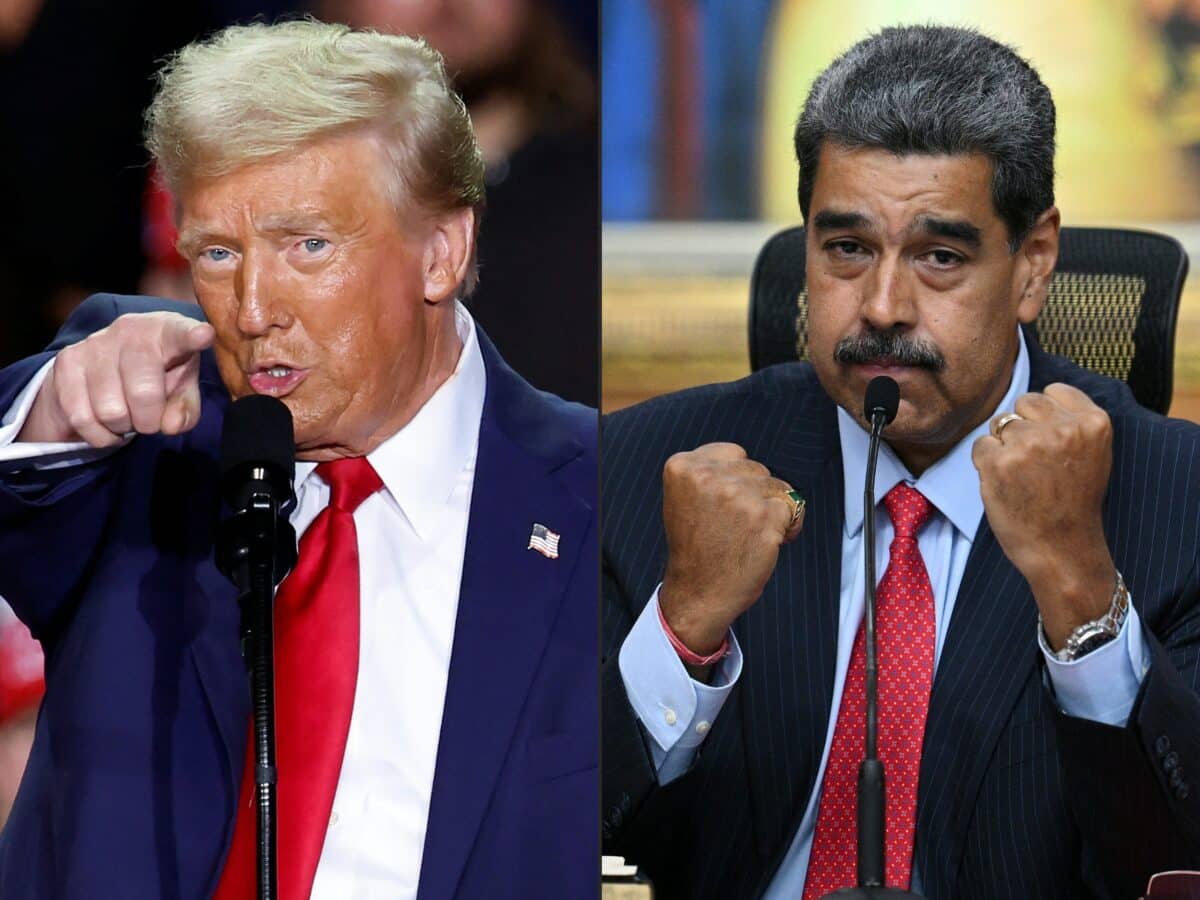
When a superpower sends his soldiers to “exfiltrate” a head of state, this is not a police operation: it's a admission of weakness. The “drugs” alibi serves as a moral backdrop, but the scenario is always the same: strategic resources, monetary control, dollar first. Venezuela is no exception - it's the 2026 version of an imperial reflex: when the greenback loses its magic, Washington resorts to force. And if you think this doesn't concern us, read the Swiss gold ultimatum again: same logic, same empire, same methods.
On 3 January 2026, Washington crossed a threshold: a military operation in Venezuela resulted in the capture of Nicolás Maduro and his transfer to the United States under the guise of a «war on drugs».
This is not an “event”: it is an admission. When a power has to remove a foreign head of state from its territory to “save order”, it means that its order is no longer consensual - it is imposed.
And what is imposed, behind the moral decor, has a name: the survival of a fiat monetary system which is no longer held together by trust... but by constraint.
1) «Drugs»: a convenient alibi, not a legal basis
The official argument is well known: Maduro is the target of US prosecutions (drug trafficking/narcoterrorism), and the operation would be a strong extension of this logic.
However, even in the field of international law, legal experts and diplomats are already describing the operation as a "war on terror". assault and a violation of sovereignty, precisely because criminal charges do not create a right of invasion.
When ethics are used as a pretext for the use of force, it is no longer justice: it is domination dressed up as virtue.
2) 303 billion barrels: the real reason lies underground
Venezuela holds 303 billion barrels of proven reserves — the largest in the world - and about 17% of world reservesaccording to recent estimates.
This figure dwarfs everything else. And it also explains why, as soon as the capture was announced, the markets and observers were already talking about a “comeback” by the companies and a shift in the sector.
Trump, for his part, makes no secret of the fact: he has publicly spoken of ’exploiting“ Venezuela's black gold and ”administering’ the country.
It's no longer a moral crusade: it's a confession of predation.
3) The sinews of war: protecting the dollar empire
They'll say “drugs”, “democracy”, “stability”. The real issue is the currency.
Yes, the “petrodollar” is not a single treaty set in stone. Experts point out that there is no simple formal pact that “all oil must be sold in dollars” - it's more like a "petrodollar". system(invoicing, recycling of surpluses in US assets, security, alliances) which has made the dollar central.
But that's just it: a system defends itself when it is threatened.
For years, however, Venezuela has been sending out more and more signals that it is circumventing the dollar (de-dollarisation, alternative regulations, closer ties with China). In particular, it has encouraged payment and quotation mechanisms that are less dependent on the dollar, including via China.
And while Washington is brandishing SWIFT and sanctions, Beijing is building rails: CIPS (cross-border payments in RMB) account 190 direct participants and 1,567 indirect(end 2025).
On the central bank side, projects such as mBridgeare explicitly aimed at reducing the friction of cross-border payments (and therefore dependence on Western infrastructures), even if their promoters deny that they are an “anti-sanctions” tool.
Translation : the dollar monopoly is being eroded by technology, not rhetoric. And when technology advances, the empire reacts with the old reflex: force.
4) The historical pattern: official morality, monetary objective
This scenario is not new:
- Iraq (2000) Baghdad obtains UN approval to sell its oil from the “oil-for-food” programme in euros.
- Iraq (2003)Iraq: invasion justified on the grounds of “weapons of mass destruction”, which would not be found as an operational stockpile; the Iraq Survey Group's final report concluded that there were no significant stockpiles at the time of the invasion.
We can debate the exact causes, the multiple responsibilities, the errors and the cynicism. But the mechanics of communication are constant: you sell a moral code, you get strategic leverage.
5) The link with gold and Confederation: same logic, different theatre
Our opinion piece on Swiss gold was right: when Washington gets its hands on a real asset, it gets its hands on power.
The Confederation is a global hubof the metal: the SNB and official analyses point out that major refineries in Switzerland supply a very large proportion of the world's refined gold (estimates vary widely depending on whether we are talking about “newly mined” gold or all refined flows).
And in recent years, the “gold-tariffs-US-pressure” issue has already entered the Swiss economic mainstream.
Oil (Venezuela) or gold (Switzerland), it's the same nerve:
- control the chain (extraction/refining/flow),
- control the standard (jurisdiction, sanctions),
- control the settlement currency (dollar or nothing).
Conclusion: a currency that needs bombs is no longer a currency - it's a payment order.
The Maduro affair is not just an operation. It is a message sent to the world:
“Challenge the dollar, and you'll see how far we'll go.”
And that is precisely why the Confederation must hold its line: real assets, monetary sovereignty, national infrastructures, refusal of imposed extraterritoriality.
For modern imperialism does not begin with tanks. It begins with money - and ends with force when money is no longer enough.
We analyse what the media keep quiet. What Berne negotiates, we dissect. Join our HQ on Telegram now: https://t.me/swisssovereignty